- Written by Reporter and Journalist: Yeeun Yoo (she/her)
–
I once read an annotation from a used copy of Don Mee Choi’s Hardly War: “How do we remember and why?”
I REMEMBER BECAUSE I AM FORCED TO REMEMBER…
My memory at seven years old continues to haunt me. At seven years old, I learned that I was a canvas for politicization by my white peers. Before learning or hearing the words “north” or “south” from my parents, I heard them first from the white spaces where I grew up. They would taunt me during recess, chase me to a tree at the back of the field, and interrogate me, asking if my family “escaped” the “evil” hands of Kim Jung Un. I knew the answer they wanted; I knew their questions were meant to alienate me. But I would accept the bait. I would play along. From that day, I promised myself I would only be ‘south’ Korean. I thought that by semantically aligning myself to the Republic of Korea (ROK), I would somehow be more palatable to my white peers—perceived as less of a threat or an enemy. I foolishly believed. Because at seven, all you can really do is believe. At that delicate age, I let myself become a guard of the 38th parallel, a puppet for the imperialists, a tool of militarism. I was conditioned to believe in the vilified stories of ‘north’ Korea, to hate the northern half of my people, and to glorify the American occupation for “protecting” the south. I learned that my future, my choices, my return home, or even my journey to find a home outside the motherland would always be political.
I REMEMBER BECAUSE REMEMBERING IS PART OF MY ARTMAKING…
From my earliest memories, I knew I was an artist—an artist out of desperation. I zealously search for words that can somehow adequately fill the hole in my heart that the colonizer’s bullet has penetrated. I desperately search for the stories that can manifest my rage, the stories that can explain my melancholy state of mind, the stories that can justify the bitter taste in my mouth when I mention my divided motherland. I am an artist because if not an artist, I do not know who I am.
To break free from the propagandized narratives of my motherland, I have become this desperate artist. I have channeled this desperation into art and storytelling, which provides a sense of liberation from the suffocating compartmentalizations of white colonialism. I am not alone in my struggle to find myself through the stories I write, the stories I tell, and the stories I read. For colonized folks, we are told how to exist. We are subjected to orientalist tropes that are hypersexualized, villainized, and disparaged. We are labeled as “cyborgs,” “diseases,” and “animals.” We are stripped of our humanity and categorized by the white man’s perception of race and culture. We are dictated by these oppressive structures. We are stolen and dispossessed. Yet, we emerge as artists.
I REMEMBER BECAUSE THE ACT OF REMEMBERING IS A SHARED STRUGGLE…
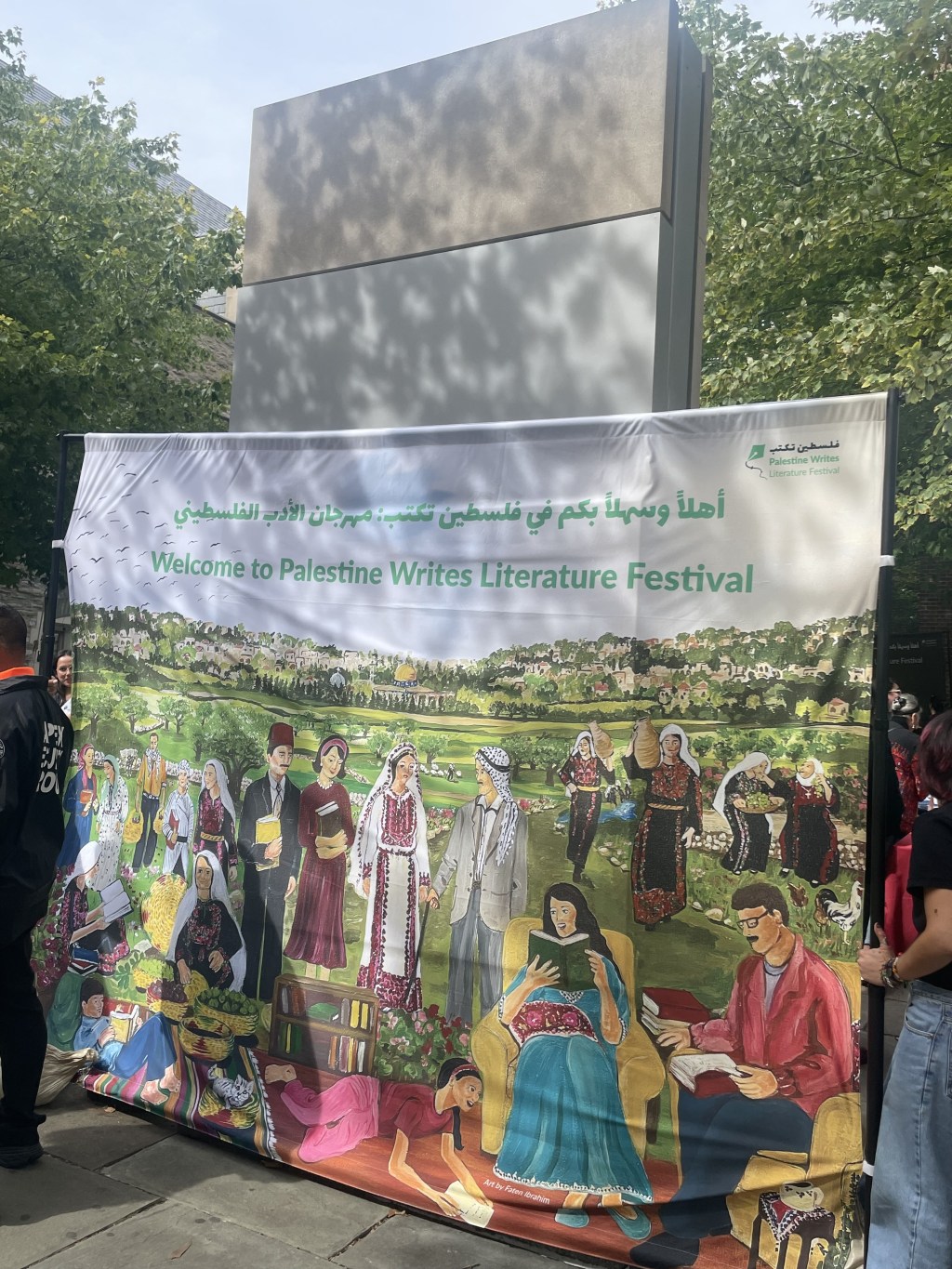
Back in September of 2023, I had the privilege of attending the Palestine Writes Festival hosted at Penn as a member of the press. This festival, dedicated to celebrating the rigor and resistance of Palestinian literature and meeting fellow literary lovers and organizers, was belittled, disparaged, and villainized by false claims. Again, this university and all structures of this neoliberal state continue to vilify the Palestinian people in every form of their existence: from their steadfast fight against their settlers to their art and stories of relentless struggle.
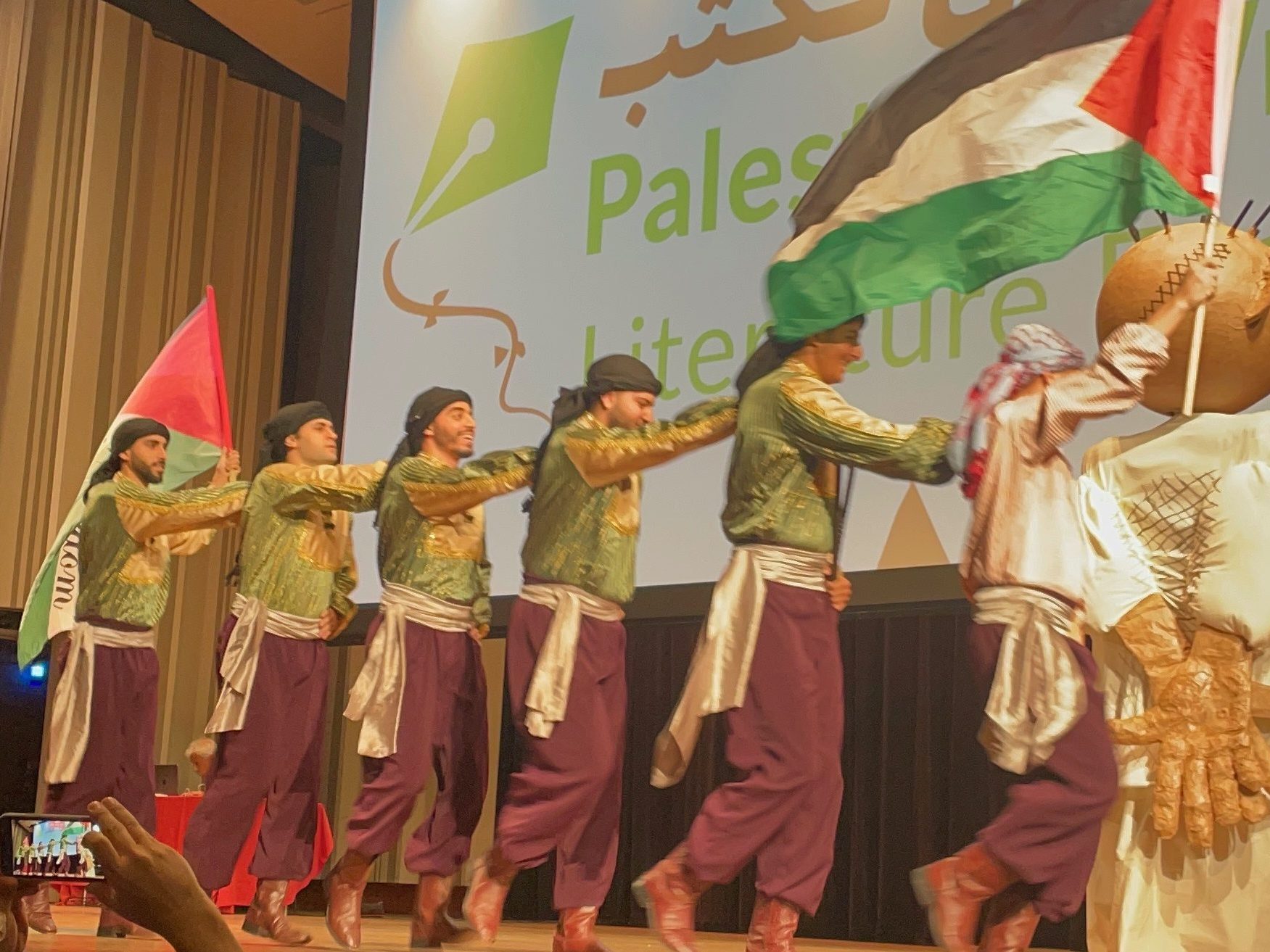
I distinctly remember my first day at the festival as I watched the Freedom Dabka Group give us a beautiful opening performance, urging the audience also to clap and sing along. This simple invitation to celebrate together only shows once more the utter mendacity of any berating news headline of the event. There can simply be no accurate publication or press on the Palestine Writes Festival without writing about its ardent love and community. Coverage that omits the illuminating resistance echoed by each panel is misconstruing the festival.
But following its conclusion, I was told by the editors of the publication I was representing as a press member that I could not be “political” in my writing about the festival. I was told to be ‘objective,’ ‘neutral,’ whatever the fuck that meant. I was essentially told to censor what made the festival what it was: unapologetically political and unwaveringly Palestinian.
So, I quit that publication.
Because indeed and doubtlessly, there is no such thing as “art for art’s sake.” When our very existence has been politicized, it’s impossible to declare our art as apolitical. Neutrality in art is a Westerner’s delusion. It is a form of suppression. It is deliberate repression. And it is disingenuous.
As a journalist, I truly could not formulate any writing without being political because every panel I attended was unfalteringly militant and belligerently political. I would be lying to claim otherwise. But also, as an artist tormented by my and my family’s memories of military occupation and a war that never ended, I would be betraying my memories and the memories of my ancestors to deny that there is not a shared political fight.
One panel, led by organizers of the Palestinian Youth Movement, showcased this unwavering struggle, resilience, and solidarity of young Palestinians and other colonized folks across the world. They recounted how Palestinian youth ceaselessly, tenaciously fight for the undebatable, inevitable free Palestine while dreaming about and organizing toward the collective road to get there. They spoke on the vitality of a “multifaceted struggle,” a struggle that sustains the Palestinian Youth Movement’s strength. They closed the panel by asserting proudly, “As always, we’ll see you in the streets!”
Indeed and inevitably, the festival presented this dialogue of struggle that not only creates solidarity but also sustains a culture of resistance. It is this struggle that has cultivated Palestinian art and art by all colonized folks. It is this struggle that confronts the colonizer, dissents the narrator, and reclaims the story. It is this desperate struggle as an artist where we can find snippets of sanity in the midst of a storm. It is this art born out of desperate longing, anguished yearning, and the zealous pursuit for liberation.
I spoke with multiple artists as they shared their experiences utilizing art as a vessel for organization and struggle. It is ingenuine to profess that our art is not part of our desperate longing for liberation. It is distorted and fallacious to reduce art as “simply art” (whatever the fuck that means) when this form has been historically and continuously used to revitalize, reclaim, and revolutionize for resistance.
I talked with poet, writer, and storyteller Melody (pseudonym). Melody redefines and reimagines art because art “plays such a huge part in revolution and revolutionary history.”
“Art is obviously a tool, and I think people who treat it as something that’s sacred or above reproach are really closing themselves off to a lot of the critique that needs to be made about certain pieces of art,” they say. “And separating art from the artist is also not really a thing…what separates art from the artist is not meant to shield the artists from repercussions.”
Simran Bains is a writer who is currently working on her first debut novel, which confronts the terrors and truths of religious trauma and colonial subjugation justified under the divinity of religion.
“The idea that art can be apolitical is a political stance in and of itself. To be able to say that your art exists outside the realm of politics comes from a place of privilege in which your identity has not been politicized against your will,” she tells me. As a daughter of survivors of the 1984 Sikh genocide, she knows this all too well. “Because art is informed by your identity and your identity as a result of centuries of systemic oppression…it becomes inherently political in that way.”
Vianna Nguyen is another artist who challenges the rules and realms of art. “There’s a lot of discussion about whether or not artists [and also] creators, and writers…create political work. And my answer is always yes,” she says. She’s a fine arts student concentrating in ceramics and sees a complex relationship between art, artists, and politics/culture.
“[As creators], we have a very unique privilege. We are able to get away with a lot more than the average person is able to. And because we are given [this] privilege, why not act on it? I feel like it’s a responsibility that we have to be able to act on,” she says. Vianna critically draws on this unyielding role of creators’ and artists’ responsibilities to their art. “We have unique platforms, unique audiences. And it’s like, if we’re not talking, then who is?”
Vianna critically draws on this unyielding role of creators’ and artists’ responsibilities to their art. But what about the readers, the critics, and consumers of art? How do we fit into this harmony or tension of art, and in many ways, how are we artists as well? I also wanted to ask them more about the art-making process and their distinct stories as artists.
—
[These interview excerpts have been edited for length and clarity.]
Do you face any challenges you’re comfortable sharing when creating art—personal or external?
Melody shares the challenge and their current praxis of detaching artmaking to the pervasive nature of capitalist productivity: “I think that I am trying to see art as less of a product that I have to be working towards constantly, and more of a practice, you know? I can tell myself that if I’m good at this thing, in 10 years, I’ll be really happy. And it’s okay that I’m not good at this thing today or tomorrow. But as long as I do a little bit every single day, I can get to a place where I’m happy with my skills. I try not to put a lot of pressure on it. I try not to do it for money. I try not to do it for attention because all of those things that you put on your art are only going to make it so much more difficult. I try to use my art to reflect my political ideas, to express my political ideas, or to spread information about my political ideas. From my nail practice, for example, I love painting nails, but I only have two hands, you know. So, I like to paint nails for friends and family. And it seems like such a little thing. But I truly believe that everyone deserves to have access to pretty little items and things that make them happy and things that make them feel good. And I just found nails to be such a confidence booster for myself. And it’s so expensive now[adays], and so I really, really tried to make it accessible for everyone. I try to charge $10 or $15—only enough to cover the supplies because I love to do it. And it’s a way for me to expand my artistic practice. And it’s a way that I can provide my friends with beautiful things. And so that is a way that I think that my political beliefs and my ideas about art kind of intersect.”
Simran, as a writer, sheds light on the exclusive and censored realities of publishing spaces:
“I think on a personal level, I feel as though a lot of Asian women, in particular, have always been sort of pushed away from creative fields, especially if we are creating something that is very openly political in nature. For me, that was definitely something that I had to work to get over because it was so internalized. Just the idea that nothing I said was new or anything I said mattered because someone else would probably say it for me. And regardless of how, who, and why, if someone tries to strip that away from me, it is inherent to my existence…I think, especially existing in a post-Civil Rights Act world where a lot of people want to have a sort of “colorblind” conception of reality that we know is empirically untrue. It’s kind of difficult to want to tell stories that you want to tell because I think that a lot of creators of color want to avoid being cliches. I think someone who touches on this very beautifully is R. F. Kuang, a very, very decorated author in the science fiction and fantasy world. Still, she released a satirical novel called Yellowface, which essentially is a satire about a white author who witnesses the death of her Asian friend, who is a much better and much more successful author and steals her manuscripts. And what I found really beautiful about that novel is that it highlights the injustice within the publishing community and how publishers want to have diversity, but only at face value. They want people of color to act as pictures on their website to show how diverse they are rather than telling the stories they want to tell. But [it’s] also how art can be usurped by the colonizer for their purposes. I think that’s something that, as I go forward and as I write, I want to make sure that I’m not falling victim to…It’s just so hard as a person of color to be published, especially if you want to tell stories that they don’t think you should be telling.”
Lastly, Vianna tells me:
“My first year of undergrad [at this university] was a very bad environment to be in to make political art. I did a piece—it was a group project- basically during [the early height of] COVID. Our assignment was to create a group exhibition and to make it accessible to people. I made this website so that we could all put [our pieces] on[line]. And our overarching theme was the Vietnam War. A big struggle we had when we had critique was that our white professor was, well…he was talking to me specifically, but he was like, I’m just not sure if your connection to the Vietnam War is intimate enough to be making a project like this… acting like me being Vietnamese American hinders me from understanding this. He’s like, My uncle fought in the Vietnam War… And I was like, Oh my god, did that just come out of his mouth in front of all these people? But the thing is. The thing is, no one else said anything and it was like whatever… So that’s actually why I left. Like no one said anything. I was like, wow…”
My final question for the artists was, What message do you hope to share through your art?
Melody pauses before answering, “Honestly, the best thing that I think that people could take from my art is that everyone should be able to access it and everyone should be able to do it. And everyone should be able to make art that is beautiful and also in a way that is accessible to them because art can be so inaccessible—material-wise, but even the practice…You can’t put your art out there unless it’s at a certain skill level or there are rules. I think Fuck the rules! Make art!”
Melody continues, “I think someone who again has been a huge inspiration to me for this has been my partner…They used to run a zine library, and they were showing me all the designs that they made…And one of the zines is called “$17,000.” And it was just different pictures of pink items that formed one pink outfit that is worth $17,000.It’s just like a random fit, but it’s so beautiful and has such a specific thought and intention behind it…I think a lot more people need to get fucking weird, even if it’s really weird, that is the best art, and they just need to pursue it.” Melody creates art with this deliberate intention to ensure accessibility for all folks because they believe art should not be limited or constrained by bourgeois barriers or rules of who is included and/or excluded.
Simran tells me, “Growing up where I did, I wish more people would have been open to the idea that it’s never too late to stop being a shitty person. It’s never too late to understand the harm that you were doing and then begin actively working to unlearn that and to attempt to mitigate some of the damage that you’ve done. And so I hope by reading the work that I’ve done, people see that as an opportunity—a jumping off point to do some actual self-reflection and learning.” Simran reminds us of art’s potency and vigor in sharing knowledge and fostering hope.
Vianna takes a deep breath before starting, “I think I am trying. I think I know that I have a space in this world as an artist. But I think it’s more I’m trying to prove to myself that I have room to exist as myself within my own space. I know that my art has a space. And there’s room for me in the art world. But I think I’m trying to prove to myself that I can exist as myself.”
—
I REMEMBER BECAUSE REMEMBERING IS RESISTANCE…
Art is embedded in our existence. We create art to exist. We create art to “prove” to ourselves that we can exist as ourselves, that we are allowed to take up space, that we can make space, that we can touch, that we can cry, that we can scream, and that we can resist by any means necessary. We create art that can be reproduced within the fabric of liberation and militancy, with the intention and culture of dissent, through the movement to mobilize and combat the settler.
You cannot find liberation through depoliticization… You cannot find liberation through compromises. That is not liberation. That’s deluded freedom.
The Palestine Writes Festival graciously reminds us, artists, that there is undeniable joy and ardor in resisting through our art and resisting through the memory of art and the memories that formulate our art. This festival reminded me that memory, too, is political.
My memory at seven years old continues to haunt me. I remain a canvas for politicization by my white peers. But as the years passed, I learned to take full autonomy of my politicized identity and create art out of it.
I am an artist because I am made up of a haunting collection of memories. I carry the bloodshed of my grandfather’s lineage of the Jeju people’s resistance. I bear the labor and love of my grandmothers. I absorb and exude. I retch and I swallow. I am united then I am demarcated again. I feel it vibrate in my soul, reverberate through my bones, etched in my mind. I am a desperate artist from a generation of desperate artists, storytellers, revolutionaries, and fighters.
We choose to remember through our uncontrollable desperation to create, to construct, and to destruct. We are forced to remember through our suffocating desperation to survive. Our memories have become this unapologetic testament of living and surviving, creating and destroying, reimagining and resisting.
 우리의 이야기. | our iyagi.